Reliable exams for international schools
Reliable exams measure performance consistently, so every student gets the right grade
At OxfordAQA, our high-quality assessments for international schools must pass through our rigorous student-focused assessment design process. This ensures all students taking our exams get the chance to really show what they can do.
OxfordAQA’s student-focused approach is made up of three core principles:
Validity
Reliability
Comparability
We explain how we achieve reliable exams for international schools. It explains how we design our mark schemes and the marking process to make sure that every OxfordAQA student receives a fair grade that reflects their exam performance.
Learn more about the other principles of student-focussed assessment design, validity and comparability.
Reliable exams for international schools measure performance consistently so every student gets the right grade.
This means that your students are neither advantaged nor disadvantaged by taking a different exam for the same International GCSE, AS and A-level specification at a different time.
The quality of marking is a key contributor to how reliable an exam is – but it’s not the only factor. Reliability needs to be ‘baked into’ exams from the start by focusing initially on the mark scheme.
Reliable from the start: developing the mark schemes
Valid and reliable exams for international schools need high quality mark schemes so that all examiners interpret them in exactly the same way and award marks consistently.
To do this, OxfordAQA assessment designers start developing the mark scheme for our International GCSE, AS and A-level exams alongside the exam questions. This process ensures we start with the answer we expect in mind when we write the question.
As a result, we achieve validity by ensuring our exam paper questions elicit answers that students will be rewarded for – and we achieve reliability by ensuring our examiners apply marks consistently. Learn more on how we design our question papers in this video.
We always make sure our mark schemes enable positive marking, where we credit students for what they have got right. This means that a student who performs badly on certain parts of a high mark question can still get the credit for performing well on other aspects of their International GCSE, AS or A-level exam.
After each exam series, OxfordAQA assessment designers undertake thorough reviews of exam paper questions and mark schemes. For example, they look at whether students answered the questions in the way they expected and how well the questions and mark schemes enabled examiners to award the full range of marks.
These reviews are part of a continuous quality assurance process, helping us to ensure the marks awarded differentiate student performance across the ability range in every exam series.
If you are an existing OxfordAQA teacher or Head of Department, you can find the examiner reports from our latest International GCSE, AS and A-level series here.
The marking process – the right grade for every student
At the start of the marking period of each International GCSE, AS and A-level exam series, examiners complete standardisation training to ensure they apply the mark scheme in exactly the same way.
The completed exam papers for most exams are scanned and individual questions are allocated to examiners through our online marking system.
Throughout the marking period, the work of our OxfordAQA examiners is rigorously checked to ensure their marking is consistent, fair and to the required standard.
Part of this checking process is called ‘seeding’. Highly experienced senior examiners mark a sample of answers and these are then randomly allocated to examiners. If an examiner does not mark the seed correctly, they are stopped from marking until they undergo additional standardisation training.
These rigorous training and quality assurance processes help us ensure that our marking for our International GCSE, AS and A-level examinations is consistent and reliable.
And because we invest so much research into the development of our mark schemes and exam papers, you can be sure that the final results will be the best possible reflection of your students’ abilities.
Now learn about the third principle of our student-focussed assessment design approach for international schools: how we ensure comparability when we set grade boundaries, the process that follows marking.
Mark schemes and marking resources for OxfordAQA teachers
Related News
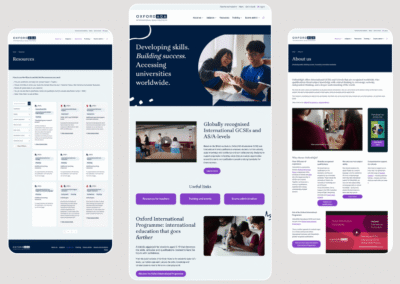
A simpler, faster way to find what you need

Teacher guidance: post-results services for May/June 2026

A major milestone for OxfordAQA in Cambodia
Become an OxfordAQA school
Register your interest to offer globally recognised qualifications and join a growing network of ambitious schools worldwide.
Working in partnership with