Valid exams
Our valid exams make sure that every student gets a grade that truly reflects their skills and knowledge of a subject.
At OxfordAQA, our high-quality assessments must pass through our rigorous student-focused assessment design process. This ensures all students taking our exams get the chance to really show what they can do.
OxfordAQA’s student-focused approach is made up of three core principles:
Validity
Reliability
Comparability
We explain how we make sure that our international exams are valid – that they only test the subject knowledge that they are supposed to test. Our unique student-focused approach maximises validity, by removing unfair bias or obstacles that prevent international students from showing what they really know. Read more about reliability and comparability.
What is validity, and why does it matter so much in international education?
Valid exams accurately measure student performance in the subject they test. To achieve this, our assessment designers remove any potential obstacles that would cause students to stumble or misunderstand questions. Our student-focused assessment approach has three key tests for all our International GCSE, AS and A-level exam papers:
- the use of vocabulary
- the choice of contexts and images, and
- the overall format of the questions.
Achieving valid exams through fair and accessible language
Of course, removing complex language is important in any exam. But it’s even more important for international exams, because many students are not native English speakers. That’s why at OxfordAQA we use a special tool to ensure our vocabulary is as clear as possible – the Oxford 3000™. This is a list of the most important and useful words to learn in English.
All OxfordAQA papers use words that are either in the Oxford 3000™ or in the qualification specification itself (so specifications will still contain relevant subject words – for example, Physics might use “electrons”).
When we design the question papers, we aim to either remove any word that isn’t in one of these two core areas or clearly define that word within the question. This means that all our papers can be benchmarked to a maximum B2 level on the Common European Framework of Reference (CEFR). This can be a real benefit for students who speak English as a second language – even those who speak English fluently.
Achieving valid exams through getting the context right for international students
The second test our papers have to pass is using only relevant context. Exams become unfair if assessment writers assume too much cultural familiarity when devising questions. For example, an exam candidate in Dubai or Bangkok who is asked to calculate heat transfer may stumble if the example given is of a British house, which is insulated to keep heat in. The choice of contexts must be carefully considered:
- is the context required for students to answer the question, or is it adding unnecessary complexity to the question?
- do students need to be familiar with the context to understand how to answer the question?
- is the context age-appropriate, and will it be easily understood in any part of the world?
During the development of each exam series, our questions go through a rigorous design process so that the contexts we use are appropriate for students living outside the UK.
Achieving valid exams through fair formatting of question papers
Thirdly, we know that the format of an exam paper has a significant impact on the fairness of the assessment. AQA researchers have studied extensively to develop the best exam formats, and here are some of the top factors we use:
Structure of units
We carefully consider how papers are divided. For example, we have separate Reading and Writing papers for our International GCSE English as a Second Language. This is so that students are not disadvantaged overall if they are weaker in one of those skills.
Clarity of question structure
Our questions make it completely clear what students are being asked to do.
We space out questions and use consistent commands, which are always at the end of the question. We also allow plenty of room for students to write their answers and show the working.
Ramping of demand
OxfordAQA exams are designed to start with easy questions and get increasingly more difficult. We often use multiple choice questions at the start of a paper to help ease students into the exam.
In our English Language exams, source texts tend to be short and frequent. This gives students a fresh start on new questions and a chance to re-engage if they have struggled with the previous text.
Use of bold words
This may look like an inconsequential detail, but the choice of which words to highlight in bold in the command can have a real impact on student performance.
For example, AQA researchers found that simply emboldening important words such as ‘shape’ in an exam question increased success from 8.3% to 37.5%.
Our commitment to innovating in assessment research allows us to ensure all our international GCSE, AS and A-level exams are valid, a key principle in student-focused assessment design.
Related News

Day-of-exam guidance: accessing urgent support

OxfordAQA celebrates global academic excellence with 2026 Go Further Awards
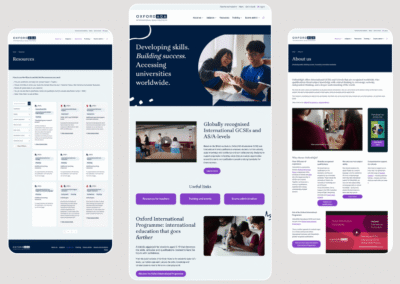
A simpler, faster way to find what you need
Become an OxfordAQA school
Register your interest to offer globally recognised qualifications and join a growing network of ambitious schools worldwide.
Working in partnership with